
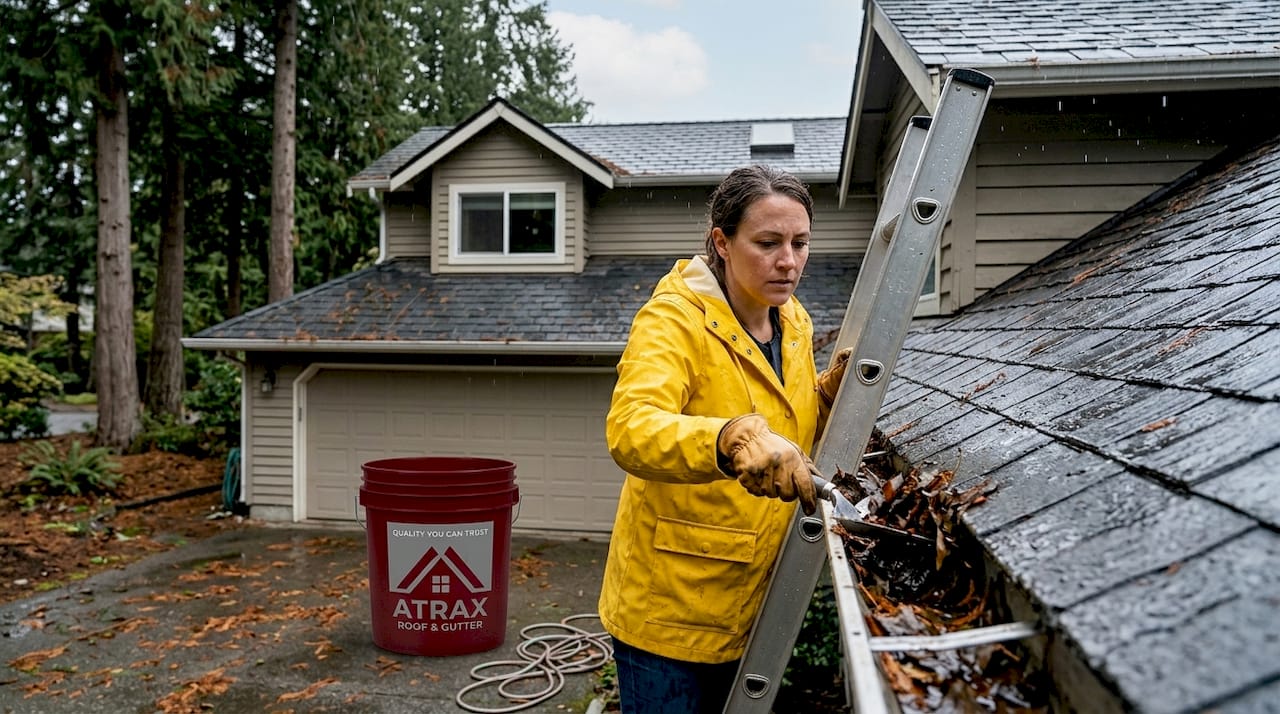
Western Washington’s rainfall doesn’t forgive neglected gutters. When gutters clog, water backs up under your roofline, seeps into your foundation, and quietly creates mold problems that cost thousands to fix. Most homeowners know they should clean their gutters, but they’re unsure exactly when, how often, and what to look for each time. This article gives you a clear, Washington-specific frequency checklist so you can protect your home before small blockages turn into serious damage.
Table of Contents
- Why gutter cleaning frequency matters in Washington
- Washington gutter cleaning frequency checklist
- What to inspect during each gutter cleaning
- How gutter guards affect your cleaning schedule
- The myth of maintenance-free gutters in Washington
- Stay safe and worry-free with professional gutter care
- Frequently asked questions
Key Takeaways
| Point | Details |
|---|---|
| Twice-yearly baseline | Most Washington homes should clean gutters in spring and fall to prevent water damage. |
| More trees, more cleaning | Homes with heavy tree cover or pine needles may need cleaning as often as every three months. |
| Do not skip inspections | Check for leaks, sagging, overflow, and moss every time you clean your gutters. |
| Gutter guards need checks | Even with guards, regular inspection is vital as debris and moss can still accumulate. |
Why gutter cleaning frequency matters in Washington
Washington State is not a forgiving environment for gutters. The Pacific Northwest brings heavy rainfall from October through April, and many neighborhoods are surrounded by Douglas firs, cedars, maples, and other trees that constantly shed needles, leaves, seeds, and organic debris. That combination is a recipe for fast-clogging gutters and serious water damage if you’re not staying ahead of it.
When gutters overflow, water doesn’t just spill harmlessly off your roof. It saturates the soil along your foundation, which can cause settling and basement leaks. It soaks into your fascia boards, which leads to rot and expensive gutter repair work. It can also push back under your shingles, creating the ideal conditions for mold and structural rot in your attic. These are not small problems. Foundation repairs alone can run $5,000 to $15,000 or more in Washington.
Common debris types in Washington gutters include:
- Pine and fir needles (which compact tightly and block water flow fast)
- Maple seeds and leaves (especially heavy in fall)
- Moss and algae (which grow year-round in the damp climate)
- Roof granules from aging asphalt shingles
- Twigs, bark, and organic film from overhanging branches
A baseline gutter cleaning schedule for most Washington homes is twice per year, in spring and fall. But that’s a starting point, not a final answer. Tree density, roof pitch, and your specific neighborhood all affect how often you actually need to clean.
“Homeowners should clean gutters in spring to remove winter debris and in fall to remove leaf and needle clogs; tree proximity determines how often beyond the baseline.”
If you have tall evergreens hanging over your roofline, twice a year is almost certainly not enough. And if your roof cleaning has been delayed, moss and organic buildup on your shingles will wash directly into your gutters during every rainstorm, accelerating blockages even further.
Washington gutter cleaning frequency checklist
Now you know the stakes, here’s an at-a-glance checklist tailored for Washington homes. Use this to build a routine that fits your specific property.
Step-by-step cleaning checklist:
- Visual inspection from the ground. Walk around your home and look for gutters that are pulling away from the fascia, sagging in the middle, or visibly overflowing with debris. Use binoculars if needed.
- Clear the troughs. Remove all leaves, needles, moss clumps, and compacted debris by hand or with a gutter scoop. Work from one end toward the downspout.
- Flush with water. Use a garden hose to rinse the gutter from the far end toward the downspout. This tests water flow and reveals any hidden blockages.
- Check the downspouts. Run water directly into each downspout and confirm it exits freely at the bottom. A slow drain means a clog inside the pipe.
- Inspect for sag and separation. Check that gutter hangers are secure and that no sections have pulled away from the roofline or from each other.
- Look for leaks at seams and end caps. Run your hand along joints while water flows through. Drips indicate failing sealant or cracks.
- Note any moss or algae. Biological growth inside gutters signals that cleaning alone may not be enough and that treatment is needed.
A simple Washington homeowner frequency checklist recommends cleaning in spring and fall by default, with additional mid-season checks if you have tall evergreens, pine trees, or frequent wind events that refill gutters quickly.
Here’s a quick reference table based on your property’s environment:
| Property type | Recommended cleaning frequency |
|---|---|
| Minimal tree coverage | 2 times per year (spring and fall) |
| Moderate tree coverage | 3 times per year (add mid-summer) |
| Heavy evergreen or pine coverage | 4 times per year (quarterly) |
| Homes with moss or algae issues | 4 times per year plus treatment |
| Homes with gutter guards installed | At least 1 to 2 times per year |

Pro Tip: Mark your cleaning dates on your calendar the same way you schedule HVAC filter changes. Gutter maintenance that gets scheduled gets done. If you wait until you notice a problem, you’ve likely already got water damage starting somewhere.
If your gutters are aging or pulling away from the fascia regularly, it may be time to consider gutter replacement rather than repeated patching. New seamless gutters with proper sizing for your roof’s drainage load can dramatically reduce how often you deal with overflow issues.
What to inspect during each gutter cleaning
Knowing when to clean is only half the solution. What you look for during each cleaning determines whether you catch small problems before they become expensive repairs.
Many homeowners treat gutter cleaning as a simple debris-removal task. They scoop out the leaves and call it done. But a thorough cleaning visit is also your best opportunity to catch early warning signs of damage that can be fixed cheaply now or expensively later.
Here are the key things to look for during every cleaning:
- Overflow marks on the fascia. Dark staining or paint peeling below the gutter line means water has been running over the edge repeatedly.
- Rust or corrosion spots. Even on aluminum gutters, standing water can cause oxidation at low points where debris pools.
- Cracks or holes. Small cracks in the gutter trough can often be sealed with gutter caulk before they grow into full breaks.
- Loose or missing hangers. Gutters that sag between hangers will hold standing water and eventually pull away from the fascia entirely.
- Downspout discharge location. Make sure water exits at least 4 to 6 feet away from your foundation. Extensions are inexpensive and prevent major problems.
The seasonal inspection checklist covers debris load in the trough, overflow behavior at corners and edges, downspout flow, gutter sag and separation, and signs of moss or vegetation growth. These aren’t optional extras. They’re the difference between a 30-minute maintenance visit and a $3,000 repair call.
Here’s a quick reference for what you might find and what it means:
| What you see | What it means | Urgency |
|---|---|---|
| Debris-packed trough | Cleaning overdue | High |
| Sagging gutter section | Hanger failure or weight stress | High |
| Water stains on fascia | Overflow or leak present | High |
| Moss inside the trough | Biological buildup, drainage slowing | Medium |
| Minor crack at seam | Sealant failure beginning | Medium |
| Slow downspout drainage | Partial clog forming | Medium |
| Granules in the trough | Roof shingles aging | Low to medium |
Pro Tip: If you find a small crack or loose hanger during cleaning, fix it the same day. A $5 tube of gutter sealant or a $2 replacement hanger takes five minutes. Waiting until next season often means the damage has spread and now requires a professional repair visit. For guidance on keeping your entire roofing system in good shape, roof maintenance tips can help you build a complete year-round plan.
Understanding why gutters overflow in the first place is also valuable, because sometimes the cause isn’t just debris. Undersized gutters, improper slope, and downspout placement all play a role.
How gutter guards affect your cleaning schedule
If you’re considering or have installed gutter guards, your checklist gets a few essential additions. Gutter guards are marketed heavily as a low-maintenance solution, and they do offer real benefits in the right situations. But in Washington’s climate, the story is more complicated.
Gutter guards reduce cleaning frequency but do not eliminate maintenance, and their performance depends heavily on the product type and installation quality. This is a critical point that many homeowners miss after spending $1,500 to $3,000 on a guard system.
Here’s what you need to know about guards in Washington:
- Micro-mesh guards are the most effective at blocking fine debris like pine needles, but they can develop a thin organic film on the mesh surface that slows water flow over time. They need periodic rinsing.
- Solid cover or reverse-curve guards can create a shelf where needles and seeds accumulate on top rather than falling off. In heavy-needle zones like Kirkland or Bothell, this can become a significant issue.
- Foam and brush-style guards tend to trap debris inside the foam itself, which can actually make cleaning harder than if no guard were installed.
- Even well-installed micro-mesh systems should be inspected at least once a year, and twice a year in tree-heavy areas.
“Gutter guards can reduce how often you must clean, but they do not eliminate maintenance, and performance depends on product type and installation alignment.”
If you have guards installed, add these steps to your checklist: inspect the top surface of the guard for debris buildup, check that the guard is still properly seated along the entire gutter run, and verify that water is actually entering the gutter rather than sheeting over the guard during heavy rain. For more insight on overflow behavior with and without guards, our gutter guard insights article covers common failure patterns in detail.
The myth of maintenance-free gutters in Washington
With all the checklist steps in mind, it’s worth reconsidering what true home maintenance means in our state.
We’ve worked on hundreds of homes across Kirkland, Bothell, Redmond, Bellevue, and Seattle over the past decade. One pattern we see repeatedly is homeowners who invested in premium gutter guards, assumed the problem was solved, and then called us two or three years later with significant water damage. The guards were still physically in place. They just weren’t working.
Here’s the uncomfortable truth: Washington’s climate is simply too aggressive for any passive, set-it-and-forget-it gutter solution. The combination of constant moisture, biological growth, and year-round needle shedding from evergreens means that even the best products need human attention. A micro-mesh guard that works flawlessly in Arizona will develop an organic film in a Redmond neighborhood within 18 months.
We’re not saying guards aren’t worth it. Many of our customers benefit from them because they extend the time between full cleanings and reduce the volume of debris inside the gutter. But the marketing language around “lifetime maintenance-free gutters” is simply not accurate for Western Washington conditions.
If you confirm that guards are positioned correctly and designed to avoid creating a shelf where needles and organic film collect, you’ll get much better performance. But that confirmation requires a physical inspection, which means someone still has to get up there and look.
The homeowners who avoid costly water damage are the ones who stay hands-on. They follow a schedule, they inspect what they clean, and they call a professional when something looks off. That proactive approach costs far less than the alternative. Staying current on gutter repair needs before they escalate is one of the smartest investments you can make in your home’s long-term value.
Stay safe and worry-free with professional gutter care
Following a cleaning checklist is empowering, but there are times when the job calls for professional eyes and hands. Climbing a ladder on a wet Washington day carries real risk, and some gutter problems, like improper slope, failing fascia boards, or undersized downspouts, require more than a scoop and a hose to fix properly.

At Atrax Roof & Gutter, we handle everything from routine seasonal cleanings to full professional gutter repair and complete gutter replacement service for Washington homeowners. We’re licensed, bonded, and insured, and every job comes with honest communication and no-surprise pricing. If your gutters are showing signs of damage, sagging, or overflow, or if your roof needs attention alongside your gutters, our roof repair services are available across Kirkland, Bothell, Redmond, Bellevue, Seattle, and surrounding communities. Let us help you protect what matters most.
Frequently asked questions
How often do Washington homes need gutter cleaning?
Most Washington homes need cleaning at least twice a year in spring and fall, but homes with heavy tree coverage may need cleaning every three months to prevent overflow and damage.
Do gutter guards eliminate cleaning?
No. Gutter guards reduce cleaning frequency but do not eliminate maintenance, since debris, organic film, and moss can still accumulate on or inside the guard system.
What should I check during each gutter cleaning?
Look for debris in the troughs, check overflow behavior at corners and edges, test downspout flow, and watch for sagging sections or algae growth that signal bigger problems.
Is more cleaning needed with many trees near my house?
Yes. Homes with tall evergreens or dense tree coverage may need cleaning every three months, especially in Seattle and Tacoma area neighborhoods where needle shedding is constant and heavy.


Pingback: Annual Gutter Maintenance in Washington: Schedule, Costs, and What Each Visit Should Cover - Atrax Roof & Gutter