
Knowing which questions to ask a roofing contractor before signing anything is the single most effective way to protect your home, your wallet, and your family in Washington State. Contractor vetting, the formal practice of evaluating a roofer’s credentials, warranties, and work processes before hiring, separates reliable professionals from costly mistakes. Washington State has specific licensing, bonding, and permit requirements that make this process different from other states. Ask the right questions upfront and you set clear expectations, confirm legal compliance, and lock in warranty protections that last for decades.
What to ask a roofing contractor about license, insurance, and registration
Washington State law requires every roofing contractor to be registered with L&I and carry an active surety bond, liability insurance, and workers’ compensation coverage before starting any job. This is not optional. Hiring an unregistered contractor puts you at legal and financial risk if a worker is injured on your property or the work fails inspection.
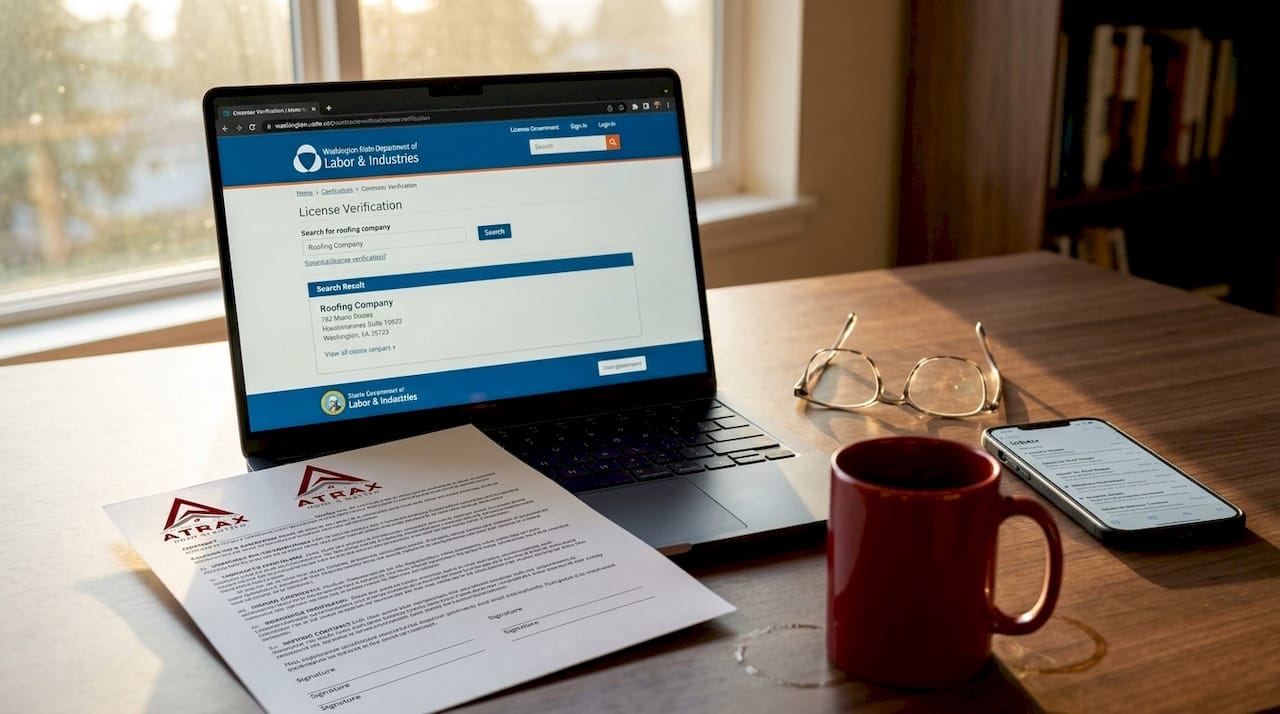
The minimum requirements are specific. Washington contractors must hold a $12,000 surety bond, maintain current liability insurance, and keep workers’ comp active. An “Active” registration status is the only status that confirms legal compliance. “Expired” or “Inactive” registrations are red flags, not minor paperwork issues.
Here is what to verify before signing any contract:
- Ask for the contractor’s UBI number and look it up directly on the Washington L&I contractor lookup tool
- Confirm the registration status reads “Active,” not “Pending” or “Expired”
- Request a certificate of insurance showing both general liability and workers’ compensation
- Ask who the insurance carrier is and call to confirm the policy is current
- Verify the bond amount meets the $12,000 state minimum
Pro Tip: Document every verification step with screenshots or printed records before the contract is signed. If a dispute arises later, this paper trail protects you.
What warranty questions should every Washington homeowner ask?
Warranties on roofing work fall into two distinct categories, and confusing them is one of the most expensive mistakes a homeowner can make. Manufacturer warranties cover material defects; workmanship warranties cover installation errors. They are governed by different legal frameworks, and a claim under one does not automatically trigger the other.
Ask every contractor these specific warranty questions before work begins:
- How long is the workmanship warranty, and what installation errors does it cover?
- Does the manufacturer warranty cover the full system or just individual components?
- Are there exclusions or proration schedules that reduce coverage over time?
- Is the warranty transferable if you sell the home?
- What documentation do you need to file a warranty claim?
Contractor certification matters more than most homeowners realize. GAF’s “Master Elite” program, for example, authorizes certified installers to offer non-prorated, extended system warranties that uncertified contractors simply cannot provide. Asking whether your contractor holds a manufacturer certification tier directly determines the strength of your warranty coverage.
| Warranty Type | What It Covers | Key Question to Ask |
|---|---|---|
| Manufacturer warranty | Material defects in shingles, underlayment, and components | Is this a full-system or component-only warranty? |
| Workmanship warranty | Installation errors by the contractor’s crew | How long does it last and what triggers a claim? |
| Enhanced system warranty | Both materials and labor under a certified installer program | Is the contractor a GAF Master Elite or CertainTeed SELECT ShingleMaster? |
Pro Tip: Ask the contractor to show you the actual warranty document before work starts, not just a summary. The exclusions section is where most claims get denied.
What permits does your roofing project require in Washington?
Permit requirements in Washington are not uniform across the state, and the rules inside Seattle differ from those in Kirkland, Bothell, or Redmond. Seattle exempts standard shingle replacements from building permits unless the project involves decking replacement, structural repairs, or skylight additions. That exemption disappears the moment your contractor discovers rotted decking mid-project.
Permit requirements vary even within cities, so job-specific scope clarification is the only reliable way to determine what your project needs. Ask your contractor these questions before work begins:
- Does this specific project scope require a building permit under local code?
- If a permit is required, who pulls it and who manages the inspection schedule?
- If hidden damage is found during tear-off, does that trigger a permit that was not originally required?
- How does permit status affect the validity of the manufacturer warranty?
The permit question connects directly to warranty compliance. Many manufacturer warranty programs require that work be performed to code. A project completed without a required permit can void the manufacturer warranty entirely, leaving you with no recourse if materials fail. Confirm the scope with your city’s building department before work starts, especially if your project involves any structural element beyond a straight shingle replacement.
Key questions about crew, materials, change orders, and cleanup
The execution phase of a roofing project is where most quality problems originate. Asking the right questions before work starts prevents surprises mid-project and protects you from unauthorized cost increases.
-
Who will physically perform the work? Ask whether the crew are direct employees of the contractor or subcontractors. Quality-control failures often trace back to unclear supervision and subcontractor use. A contractor who uses subcontractors is not automatically unreliable, but you need to know who is accountable for the work.
-
Who supervises the crew daily? Ask for the name and contact information of the on-site supervisor. A project manager who visits once a week is not the same as a supervisor present every day.
-
What specific products will be installed? Request the manufacturer name, product line, and color code in writing. “GAF Timberline HDZ in Charcoal” is an acceptable answer. “Quality shingles” is not.
-
How are hidden damages handled? Decking damage discovered during tear-off is a common mid-project cost driver. Ask whether decking replacement is included in the base price or priced separately per sheet, and how you will be notified and asked to approve the added cost before work continues.
-
What is the change order process? Any scope change should require your written approval before the contractor proceeds. Verbal agreements on cost changes are unenforceable and lead to billing disputes.
-
How will my property be protected? Ask specifically about tarps over landscaping, nail collection methods, and daily cleanup expectations. Roofing debris causes real damage to gutters, siding, and landscaping when left unmanaged.
Pro Tip: Request a written scope of work that lists every product by name and every labor task by description. Ask the contractor to photograph decking condition before and after installation. This documentation is your best protection if a warranty claim or dispute arises later.
How to evaluate a roofing contractor using your questions and answers
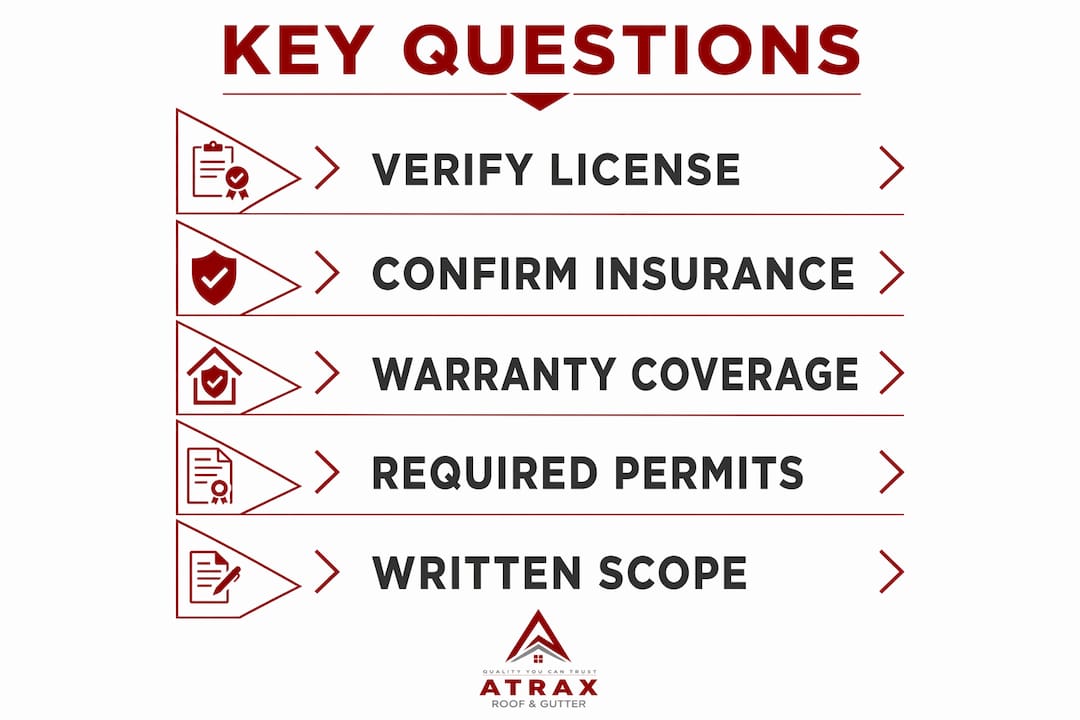
The answers you collect from your roofing contractor interview questions are only useful if you know how to compare them across multiple bids. Reading and comparing roofing estimates in Washington requires looking beyond the bottom-line price.
A contractor who bids $2,000 less but cannot confirm active L&I registration, offers only a 1-year workmanship warranty, and uses unlabeled materials is not a better deal. The risk-adjusted cost of that bid is far higher. Use your questions to build a side-by-side comparison that includes licensing status, warranty terms, material specifications, permit handling, and crew supervision structure.
Watch for these red flags during the vetting process:
- Pressure to sign a contract the same day, especially after a storm
- Refusal to provide a written scope of work before signing
- No verifiable local address or physical business presence
- Contractors who avoid documentation and resist written contracts are a consistent marker of unreliable operators
- Bids that arrive without itemized material lists
Ask for two or three local references from projects completed in the past 12 months. Call them. Ask specifically whether the final cost matched the original estimate and whether the crew cleaned up daily. Contractor certifications from GAF or CertainTeed, along with membership in organizations like the National Roofing Contractors Association, signal a commitment to ongoing training and quality standards.
Key takeaways
Asking targeted questions before hiring a roofing contractor in Washington is the most direct way to confirm legal compliance, protect your warranty, and avoid costly surprises during the project.
| Point | Details |
|---|---|
| Verify L&I registration first | Confirm “Active” status, a $12,000 surety bond, and current insurance before any contract is signed. |
| Separate your warranties | Ask about manufacturer and workmanship warranties independently; certified installers unlock stronger coverage tiers. |
| Clarify permits by scope | Seattle and other cities have exemptions that disappear when decking or structural work is involved. |
| Control change orders in writing | Require written approval before any scope change proceeds to prevent unauthorized cost increases. |
| Compare bids beyond price | Evaluate licensing, warranty terms, material specs, and supervision structure across every estimate. |
What I’ve learned from a decade of roofing in Washington
The question I see homeowners skip most often is the one about supervision. They ask about price, they ask about timeline, and they sometimes ask about insurance. But they rarely ask who will actually be on their roof every day and who that person reports to. I have seen projects where the contractor who sold the job never set foot on the property during installation. The crew was a subcontractor team the homeowner had never met, working without a clear scope document and without anyone checking their work against the original plan.
The second most overlooked area is the permit and warranty intersection. Homeowners assume that if a contractor pulls a permit, the warranty is protected. That is not always true. Some manufacturer warranty programs require specific installation methods that go beyond minimum code. If your contractor is not a certified installer for the product being installed, the enhanced warranty tier is simply not available to you, regardless of permit status.
My honest advice: write down every answer you receive during the contractor interview. Confirm registration status yourself on the L&I lookup tool. Do not rely on a contractor’s word that they are “fully licensed.” The verification takes three minutes and it is the most important three minutes you will spend on your roofing project.
— Danyllo
How Atraxroofandgutter serves Washington homeowners with confidence
Atrax Roof & Gutter was built on the belief that every homeowner deserves honest answers, not sales pressure. Founded by Danyllo Silva with over 10 years of experience, Atraxroofandgutter is licensed, bonded, and insured across Kirkland, Bothell, Redmond, Bellevue, Seattle, and surrounding communities.
Every project uses premium GAF and CertainTeed materials, and every job is backed by a 20-year workmanship warranty. You can review completed projects in the Atrax project portfolio to see the quality firsthand. Flexible financing options are available for homeowners who need to act now without waiting. If you need roof repair services or a full replacement, contact Atrax for a no-surprise quote and get every one of your questions answered before work begins.
FAQ
How do I verify a roofing contractor’s license in Washington?
Search the contractor’s business name or UBI number on the Washington L&I contractor lookup tool and confirm the registration status reads “Active.” Washington contractors must carry a $12,000 surety bond and current insurance to legally perform roofing work.
What is the difference between a manufacturer warranty and a workmanship warranty?
Manufacturer warranties cover material defects in shingles and components, while workmanship warranties cover installation errors made by the contractor’s crew. They are separate documents with different claim processes, coverage durations, and exclusions.
Does a roof replacement in Seattle always require a permit?
No. Seattle exempts standard shingle replacements from building permits, but that exemption does not apply if the project involves decking replacement, structural repairs, or skylight additions. Always confirm the specific scope with your contractor and the city building department before work starts.
What should I do if a contractor refuses to provide a written scope of work?
Walk away. Legitimate contractors provide documentation upfront and do not pressure homeowners to sign contracts immediately. A refusal to put the scope, materials, and pricing in writing is a consistent marker of contractors who create billing disputes or deliver substandard work.
How does contractor certification affect my roofing warranty?
Contractors certified under programs like GAF’s Master Elite tier can offer non-prorated, extended system warranties that uncertified contractors cannot provide. Asking whether your contractor holds a manufacturer certification directly determines the maximum warranty coverage available to you on that project.


