
If you’ve ever heard the term “roof certification” and assumed it meant the same thing as a standard roof inspection, you’re not alone. Many Washington homeowners are surprised to learn they’re two very different things, and that distinction can make or break a home sale, affect your insurance coverage, or leave you with a costly surprise repair bill. Understanding what is roof certification, how it works in Washington State, and why it matters for your home’s value puts you ahead of most sellers and buyers in the market.
Table of Contents
- Key takeaways
- What is roof certification?
- The roof certification process in Washington State
- Why roof certification matters for Washington homeowners
- Common misconceptions and pitfalls to avoid
- My honest take on roof certification
- Get your roof certified with confidence
- FAQ
Key takeaways
| Point | Details |
|---|---|
| Certification vs. inspection | A roof certification is forward-looking documentation, not just a snapshot of current condition. |
| Washington context | State licensing and permits are separate from certification, which is required by lenders or insurers. |
| Resale and insurance value | A valid certification reassures buyers and may help lower your insurance premiums. |
| Transferability matters | Transferable certifications have limited windows; missing deadlines can void warranty coverage for new owners. |
| Qualified inspectors only | Only a certified roofing professional can issue a valid roof certification, not a general home inspector. |
What is roof certification?
A roof certification is a professional written statement confirming your roof’s current condition and its estimated remaining lifespan, typically ranging from 1 to 5 years. It is issued by a qualified roofing professional after a detailed on-site evaluation. Think of it as a formal opinion letter backed by expertise and observation, not just a quick glance at your shingles from the driveway.
Here is where many homeowners get confused. A roof inspection identifies current problems and gives you a condition snapshot of your roof at that moment. A roof certification, on the other hand, is forward-looking and written, offering an assessment of how long the roof can reasonably perform before needing replacement or major repair. Some certifications may also include limited warranty coverage, but a certification by itself is not a warranty. These are related but separate documents.
A roof certification letter is the physical document you receive at the end of this process. It typically includes the inspector’s credentials, the date of evaluation, specific findings about the roof’s condition, any required repairs completed, and the estimated lifespan of the roof. Mortgage lenders, insurance companies, and buyers’ real estate agents all recognize this letter as credible third-party documentation.
Several certification programs exist, each with its own standards. Common types include:
- Standard lender certifications: The most common type, requested during real estate transactions to satisfy mortgage lender requirements.
- Insurance certifications: Used to confirm insurability, often required before policy approval.
- LeakFREE® certifications: NRCIA’s structured program involving detailed examination, a repair report, qualified repairs, and a final inspection before certification is issued.
- GAF FORTIFIED certifications: Require third-party evaluation and surpass building codes, providing enhanced insurance and resale value.
Each type serves a slightly different audience, so always confirm which certification your lender, insurer, or buyer requires before starting the process.
The roof certification process in Washington State
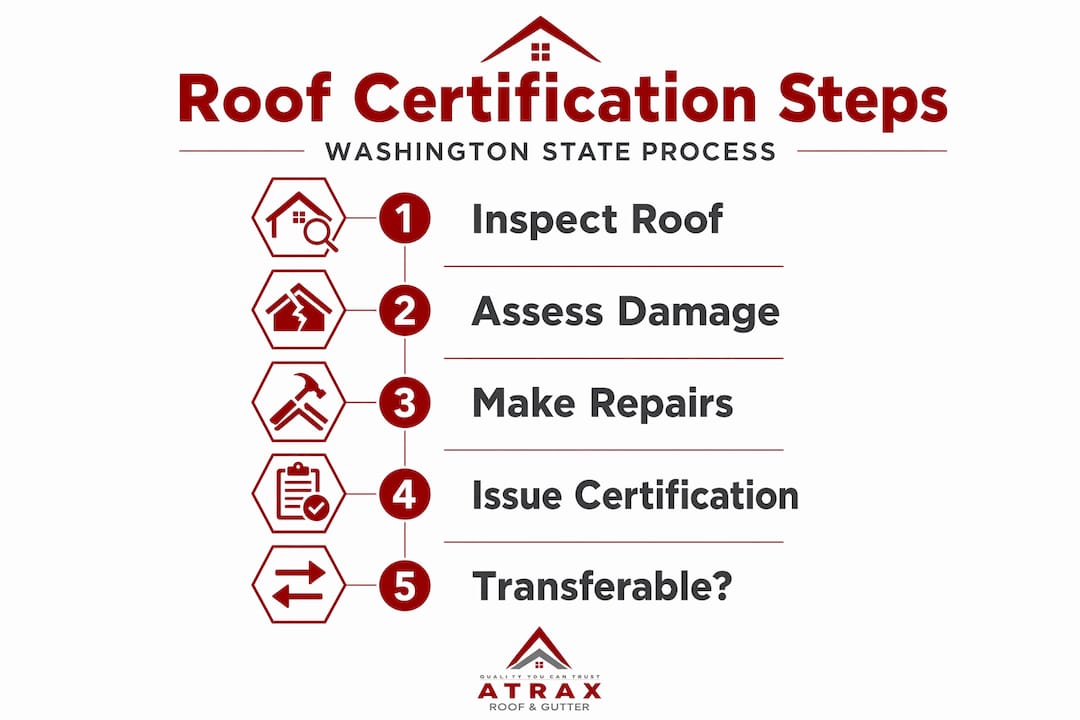
Getting a roof certification in Washington State follows a clear sequence of steps. Knowing what to expect removes the stress and helps you prepare your home correctly.
-
Hire a certified roofing professional. This is not a job for a general home inspector or unlicensed handyman. A certified roof inspector follows standardized evaluation protocols to produce an unbiased, consistent assessment. Washington State’s L&I office governs contractor licensing, and permits are handled at the municipal level. Certification is a separate, additional document beyond those requirements.
-
Schedule the on-site evaluation. The inspector examines every major component of your roof. That means shingles, flashing, gutters, ventilation, underlayment, valleys, and all drainage points. In Washington’s wet climate, leak-prone areas around chimneys and skylights receive extra scrutiny because standing moisture and moss growth are common problems here.
-
Review the inspection report. After the evaluation, you receive a detailed report outlining what was found. If the roof is in acceptable condition, the certification is issued. If there are problems that prevent certification, you’ll receive a repair list that must be addressed first.
-
Complete required repairs. If repairs are needed, you have the option to hire a qualified roofer to complete them before the final inspection. The NRCIA’s LeakFREE® process is a clear model of this: inspection, repair report, qualified repairs, and then a final verification visit.
-
Receive your roof certification letter. Once the roof passes the final check, the certification document is issued with your roof’s estimated lifespan clearly stated.
Pro Tip: Ask the inspector whether the certification is transferable before you commit to the process. If you plan to sell your home, a transferable certification significantly increases its value to potential buyers.
Washington homeowners should also understand that certification validity periods vary. A roof in excellent condition might earn a 5-year certification. An older roof that passes after repairs might only receive a 1 or 2-year certification. That lifespan estimate matters for both your planning and your resale timeline.
Why roof certification matters for Washington homeowners
The practical benefits of roof certification extend well beyond a piece of paper. For Washington homeowners, where heavy seasonal rainfall and moss growth put roofs under constant stress, having documented proof of your roof’s condition carries real financial weight.
You can read more about preparing your roof for a home sale in this Washington sellers’ guide, which covers local inspection expectations in detail.
Here is where the benefits add up:
- Smoother home sales. Buyers and their agents feel more confident when a certified professional has already assessed the roof. It reduces negotiation friction and last-minute repair demands during escrow.
- Mortgage lender confidence. Many lenders require roof certification before approving financing on older homes, particularly if the roof is 15 years or older.
- Insurance advantages. Insurance companies use certifications to reduce their risk. A certified roof may qualify for lower premiums or prevent coverage denial on a new policy.
- Proactive maintenance planning. Knowing your roof has 3 years of estimated lifespan left lets you budget for replacement strategically rather than reactively.
- Transferable value. Transferable certifications protect both sellers and buyers by passing documented roof confidence from one owner to the next.
“A roof certification gives buyers what they actually want: proof that the roof above their family’s heads has been professionally evaluated and is expected to hold up. That peace of mind has real dollar value in any market.”
The importance of roof certification becomes especially clear when a sale falls apart because a buyer’s lender demands roof documentation that the seller cannot produce. That scenario costs time, money, and sometimes the deal itself.
Common misconceptions and pitfalls to avoid
Roof certification is straightforward when you understand it correctly, but there are real pitfalls that catch homeowners off guard. Here is what to watch for:
- Not all certifications are equal. A certification issued by an uncredentialed inspector carries little weight with lenders or insurers. Always verify that the professional holds current roofing contractor licensing in Washington and follows a recognized certification standard.
- Certification is not legally required, but often contractually required. Washington State law does not mandate roof certification for homeowners. However, lenders, insurers, and buyers regularly require it as a condition of their agreement.
- State permits and certifications are different things. A roofing permit issued by your city covers code compliance for construction work. Certification is a separate document addressing condition and lifespan. Confusing the two can leave you unprepared during a sale or insurance review.
- Transfer deadlines are strict. Missing transfer windows can void warranty coverage for new owners entirely. If you receive a transferable certification, coordinate the transfer with your buyer’s agent well before closing.
- Certification has scope limits. It covers what was visible and accessible at the time of inspection. Concealed structural damage not visible from the surface is not covered. Understanding what does roof certification cover prevents unrealistic expectations.
Pro Tip: Get cost estimates for any required repairs before committing to a certification inspection. Understanding your potential repair costs upfront helps you decide whether to certify now or time it closer to a planned sale.
Certification typically costs between $150 and $400 for the inspection itself, separate from any repair costs. That investment is minor compared to the cost of a failed sale negotiation or a denied insurance policy.
My honest take on roof certification
I’ve been working on roofs in the Seattle and Eastside area for over a decade, and the one thing I see consistently is homeowners who wait too long. They call us after a buyer has already walked away or after an insurer has denied coverage. That frustration is entirely preventable.
In my experience, roof certification is not just about paperwork. It’s about knowing exactly what you have above your head. Washington’s climate is unforgiving. The wet winters and moss-prone conditions here age roofs faster than many homeowners realize. A roof that looks fine from the ground can have compromised flashing or soft spots around penetrations that only a trained eye will catch.
What I’ve learned is that water damage to a home almost always starts at the roof, and it compounds fast. A certification inspection often catches the early signs before they become expensive interior problems.
I also believe that the value of a certified roof is underappreciated in real estate conversations. Buyers remember when a seller provides clean documentation upfront. It signals that the home has been cared for. That impression translates to better offers and fewer contingencies.
My practical advice: don’t get a certification just because someone asked for it. Get it because you want to know your roof’s real condition and take control of what happens next.
— Danyllo
Get your roof certified with confidence
If you’ve read this far, you now understand what is roof certification, why it matters for your Washington home, and what to expect from the process. The next step is working with a trusted, licensed professional who can give you accurate documentation and honest guidance.
At Atraxroofandgutter, we perform thorough roof certification inspections across Kirkland, Bothell, Redmond, Bellevue, Seattle, and the surrounding communities. Our team is licensed, bonded, and insured, and we use only premium GAF and CertainTeed materials for any repairs needed before certification. Browse our completed projects to see the standard of work we deliver. If repairs are required to get your roof certified, we offer flexible financing options to keep the process affordable. Our roof repair services are backed by our 20-year workmanship warranty. Contact Atraxroofandgutter today for a no-surprise quote.
FAQ
What is a roof certification letter?
A roof certification letter is the formal document issued after a certified roofing professional inspects your roof. It states the roof’s current condition, estimated remaining lifespan, and any repairs completed prior to certification.
How long does a roof certification last?
Roof certifications typically last 1 to 5 years depending on the roof’s condition and age. A newer or recently repaired roof generally qualifies for a longer certification period.
Is roof certification required by law in Washington State?
Roof certification is not legally mandated in Washington State. It is required contractually by mortgage lenders, insurance companies, or buyers as part of real estate or underwriting agreements.
What does roof certification cover?
Roof certification covers the visible and accessible components of your roof evaluated at the time of inspection, including shingles, flashing, ventilation, and drainage. It does not cover concealed structural damage that is not visible during the inspection.
Can a roof certification be transferred to a new owner?
Yes, certain certifications such as NRCIA’s LeakFREE® program are transferable. However, transfer windows are limited, and missing the deadline can void warranty protections for the new owner, so timing coordination during a sale is critical.


