

The roof repair vs replacement decision is defined by three factors: your roof’s age, the extent of visible and hidden damage, and how repair costs compare to full replacement. Washington State homeowners face a sharper version of this choice than most, given the region’s persistent rainfall, moss growth, and rising material costs. According to Verisk’s 2026 report, average U.S. residential roof replacement costs reached $17,631 in 2025, a 33% increase versus previous years. That number alone changes the math for every homeowner weighing a quick patch against a full re-roof.
How to evaluate your roof: signs you need repair or replacement
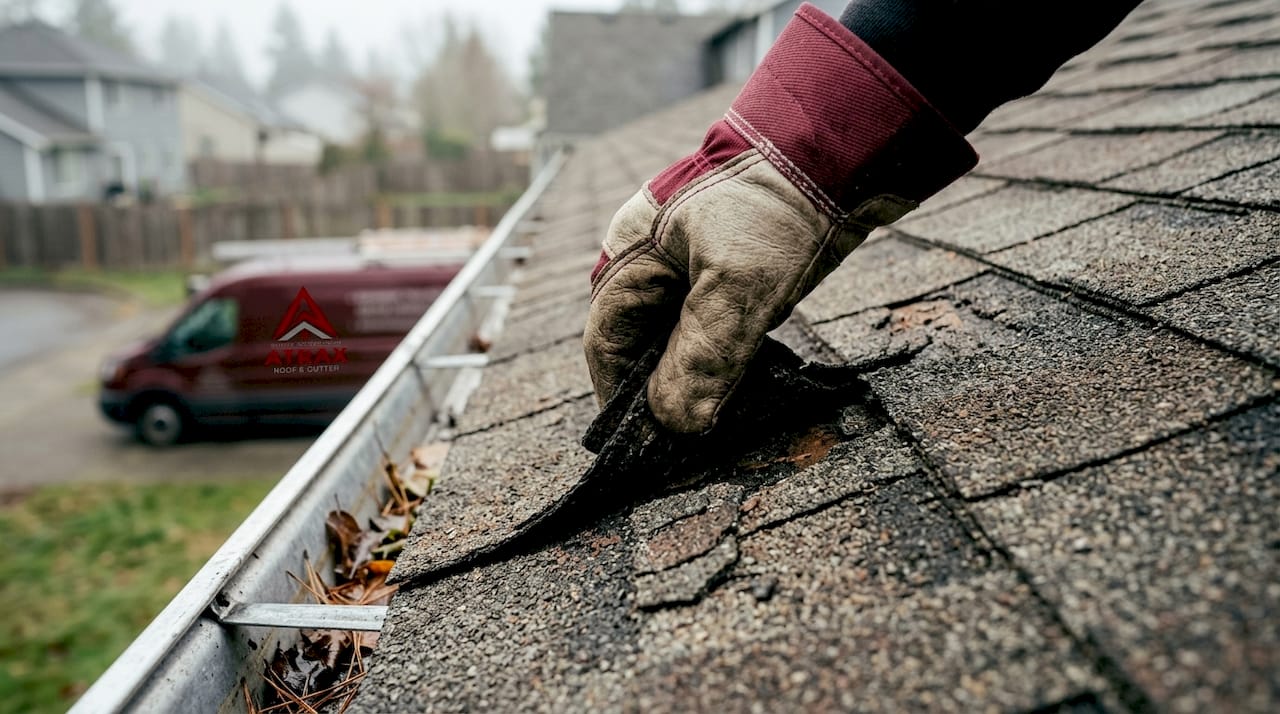
The industry term for this assessment is a roofing condition evaluation, and it covers far more than what you can see from the ground. A proper evaluation examines shingles, flashing, underlayment, decking, ventilation, and interior moisture indicators. Skipping any layer means you are making a financial decision with incomplete information.
Start with these visible warning signs:
- Missing or curling shingles: Isolated loss from storm damage often qualifies for repair. Widespread curling across multiple roof planes signals age-related failure.
- Sagging roof deck: Any visible depression or soft spot underfoot during inspection points to structural or moisture damage that repair alone cannot fix.
- Persistent leaks after prior repairs: A leak that returns within one to two seasons means the underlying cause was never addressed.
- Moss and algae growth: Common in Western Washington, moss retains moisture against shingles and accelerates granule loss. Cleaning helps short term, but heavy growth on an older roof often signals deeper deterioration.
- Granule loss in gutters: Heavy granule shedding means shingles are nearing the end of their protective life.
GAF’s 2026 guidelines state that roofs over 15 years old with more than 30% damage typically warrant replacement, while roofs with under 30% damage can often be repaired if the overall system is sound. That 30% threshold is a practical starting point, not a final verdict. Washington’s wet climate accelerates deterioration in ways that are not always visible from the surface.
Pro Tip: Schedule a professional inspection after any storm that drops hail larger than a dime or produces wind gusts above 50 mph. Damage from those events often voids manufacturer warranties if left undocumented.
Repair history matters as much as current condition. Repeated minor repairs often leave underlying issues unresolved, risking accelerated deterioration of underlayment and ventilation layers. If your roof has been patched three or more times in the past five years, the cumulative cost and ongoing risk likely justify a full replacement conversation.
What does roof repair vs replacement actually cost in Washington?
Washington homeowners face a specific cost range that differs from national averages. Local replacement costs for asphalt shingles average between $7,345 and $18,000, influenced by labor rates, moisture-resistant code requirements, and permitting fees. That range reflects real projects in the Puget Sound region, not hypothetical estimates.
| Cost Factor | Repair | Replacement |
|---|---|---|
| National average (2025) | $4,699 | $17,631 |
| Washington State range | $500 to $3,500 | $7,345 to $18,000 |
| Typical project duration | Hours to 1 day | 2 to 7 days |
| Permit required | Rarely | Almost always |
| Warranty coverage | Limited, patch-only | Full system, 20+ years |
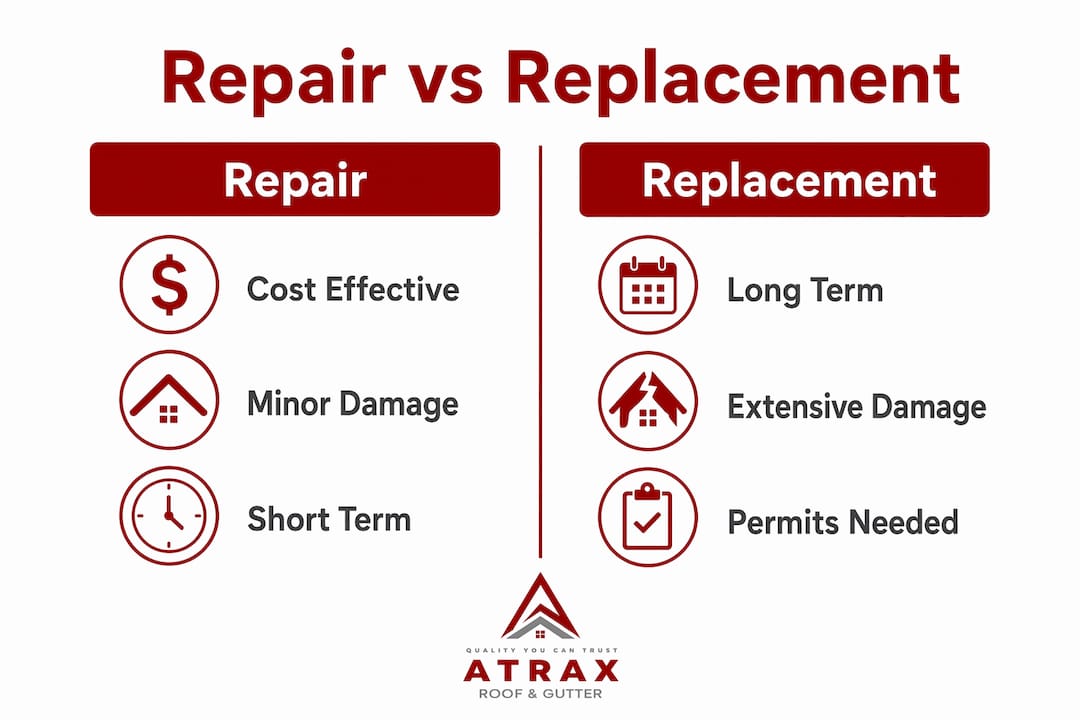
The 50% rule is the most widely used financial guideline in roofing: if your repair estimate reaches 50% or more of the cost of a full replacement, replacement is the smarter investment. At that threshold, you are spending significant money without gaining the lifespan, warranty, or energy performance of a new roof.
Hidden costs make repair look cheaper than it actually is. A compromised roof increases heating and cooling costs by 10 to 25% due to lost insulation value and air infiltration. Over three to five years, that energy loss can exceed the cost difference between repair and replacement. Washington homeowners should also factor in insurance implications. Some carriers in the Pacific Northwest now require roof replacement rather than repair for roofs over 20 years old before renewing full coverage.
Pro Tip: Get a written estimate that separates labor, materials, and disposal fees. Washington’s labor market and disposal regulations add costs that out-of-state online calculators consistently underestimate. For a detailed breakdown, the Washington replacement cost guide from Atraxroofandgutter covers 2026 ranges by material type.
Washington State permitting: what triggers a permit and why it matters
Washington requires building permits for roof replacements involving a full tear-off down to the deck. Minor patching typically avoids permit requirements, but the line between the two is not always obvious. Shoreline and other Washington jurisdictions have specific permitting processes that affect project scope, scheduling, and total cost.
Here is how the permitting process typically unfolds for Washington homeowners:
- Determine project scope. A licensed contractor assesses whether the work involves a full tear-off or surface-level patching. This single determination controls whether a permit is required.
- Submit permit application. For full replacements, your contractor files with the local building department. In cities like Kirkland, Bellevue, and Redmond, processing times range from a few days to several weeks depending on current volume.
- Schedule inspections. Permitted work requires at least one inspection, typically after the deck is exposed and before new materials are installed. This step protects you legally and structurally.
- Factor permit costs into your budget. Permit fees in Washington range from $150 to $600 for most residential roofing projects, and they are non-negotiable line items.
- Plan for weather windows. Washington roof replacements typically take 2 to 7 days depending on scope and weather. Permit timing must align with dry weather forecasts, which adds scheduling complexity in the fall and winter months.
A critical point that surprises many homeowners: permit requirements can impose unexpected delays, making the “quick repair” option far less straightforward if the work scope triggers full re-roof permitting. Always ask your contractor upfront whether the proposed work requires a permit. A contractor who cannot answer that question clearly is a contractor worth reconsidering.
Roofing materials, warranties, and long-term ROI
The benefits of roof replacement extend well beyond stopping a leak. A new roof installed with premium materials resets your warranty clock, improves energy performance, and directly affects your home’s resale value. Understanding material lifespans helps you estimate roof replacement ROI with real numbers rather than guesses.
Common roofing materials and their expected lifespans in Washington’s climate:
- Asphalt shingles (3-tab): 15 to 20 years. Budget-friendly but the shortest lifespan in high-moisture environments.
- Architectural (dimensional) asphalt shingles: 25 to 30 years. The most common replacement choice in the Puget Sound region, balancing cost and durability.
- Metal roofing (standing seam or corrugated): 40 to 70 years. Higher upfront cost but exceptional performance in Washington’s rain and wind conditions. For a side-by-side look at costs, the metal vs asphalt comparison from Atraxroofandgutter covers 2026 pricing in detail.
- Cedar shake: 20 to 30 years with proper maintenance. Aesthetically popular in the Pacific Northwest but requires regular treatment to resist moss and moisture.
- Composite or synthetic shingles: 30 to 50 years. Growing in popularity due to low maintenance and strong wind ratings.
| Material | Lifespan | Warranty (new install) | Repair warranty |
|---|---|---|---|
| 3-tab asphalt | 15 to 20 years | 20 to 25 years | Patch only |
| Architectural asphalt | 25 to 30 years | 30 to 50 years | Patch only |
| Metal (standing seam) | 40 to 70 years | 40 to 50 years | Patch only |
| Cedar shake | 20 to 30 years | Limited | Patch only |
The warranty gap between a repair and a full replacement is significant. Repairs carry patch-only coverage, meaning the warranty applies only to the specific area worked on. A full replacement with GAF or CertainTeed materials, installed by a certified contractor, provides a system-wide warranty covering materials and workmanship. Atraxroofandgutter backs every replacement with a 20-year workmanship warranty on top of manufacturer coverage.
Age and damage thresholds like the 30% damage rule and the 50% cost rule are helpful starting points, but thorough professional inspection is the only reliable way to assess hidden deterioration. A new roof on a well-maintained home in the Seattle metro area also adds measurable resale value, with most real estate professionals citing roofing as one of the top five improvements buyers notice and price into offers.
Key takeaways
The most cost-effective roof decision for Washington homeowners combines a professional condition assessment with the 50% cost rule and a clear understanding of local permitting requirements.
| Point | Details |
|---|---|
| Use the 50% rule | If repair costs reach 50% of replacement cost, replacement delivers better long-term value. |
| Age and damage thresholds | Roofs over 15 years with more than 30% damage typically need full replacement, not repair. |
| Washington costs vary widely | Local replacement costs range from $7,345 to $18,000 depending on materials and labor. |
| Permits affect timelines | Full tear-offs require permits in Washington; factor in processing time and inspection scheduling. |
| Replacement resets warranties | Only a full replacement provides system-wide manufacturer and workmanship warranty coverage. |
What I’ve learned after 10 years of Washington roofing projects
The most common mistake I see Washington homeowners make is choosing repair to buy time, without calculating what that time actually costs. A $1,200 patch on a 22-year-old roof in Kirkland feels like a win until the same area fails again 18 months later, and now you are also dealing with damaged insulation and a mold assessment. The repair did not fix the problem. It just delayed the conversation.
The decision framework for repair vs replacement that I apply on every job starts with one question: how many years of useful life does this roof realistically have left? If the answer is less than five years, repair money is almost always wasted. You are spending real dollars to extend a system that is already in decline.
I also want to be direct about inspections. The 30% damage rule and the 50% cost rule are useful tools, but they require accurate inputs. A surface inspection from the ground gives you maybe 40% of the information you need. The other 60% is in the decking, the underlayment, and the ventilation system. I have walked roofs that looked repairable from the street and found decking so saturated it crumbled underfoot. That is not a repair situation. That is a replacement with structural work.
My honest advice: get a full written inspection report before you commit to either path. Any contractor who gives you a repair or replacement recommendation without getting on the roof and checking the deck does not have enough information to make that call. Washington homeowners deserve transparent, evidence-based guidance, not a quote based on a driveway glance.
— Danyllo
How Atraxroofandgutter helps you make the right call
Atraxroofandgutter serves Kirkland, Bothell, Redmond, Bellevue, Seattle, and surrounding communities with licensed, bonded, and insured roofing services backed by a 20-year workmanship warranty. Whether you need a targeted roof repair or a full replacement using premium GAF and CertainTeed materials, our team handles permitting, scheduling, and inspections from start to finish. We provide detailed, no-surprise quotes so you know exactly what you are paying for and why. If upfront cost is a concern, financing options are available to help you move forward without delay. Contact Atraxroofandgutter today for a free inspection and written estimate.
FAQ
When should I replace rather than repair my roof?
Replace your roof when it is over 15 years old with more than 30% damage, or when repair costs reach 50% or more of full replacement cost. Recurring leaks and multiple prior repairs are also strong indicators that replacement is the better investment.
What does roof replacement cost in Washington State?
Washington roof replacement costs range from $7,345 to $18,000 for asphalt shingles, depending on roof size, material choice, labor rates, and permitting fees. National averages reached $17,631 in 2025 according to Verisk’s 2026 report.
Do I need a permit to replace my roof in Washington?
Yes, full tear-off replacements require a building permit in Washington State, including cities like Shoreline, Kirkland, and Bellevue. Minor patching typically does not trigger a permit, but the scope of work determines the requirement, so confirm with your contractor before starting.
How long does a roof replacement take in Washington?
Most Washington roof replacement projects take 2 to 7 days depending on roof size, material type, and weather conditions. Permit processing adds additional lead time, particularly during high-volume seasons in spring and fall.
Does a new roof increase home value?
A new roof improves resale value and buyer confidence, particularly in the Pacific Northwest where buyers scrutinize roof age and condition closely. It also restores energy efficiency, reducing heating and cooling costs by 10 to 25% compared to a compromised roof.


