
Replacing your roof in Washington State is one of the biggest home investments you’ll face. The cost can land around $21,493 for a typical asphalt roof, and that number alone is enough to cause real stress. But the goal isn’t simply to spend the least money possible. It’s to spend wisely, protect your family, and avoid the expensive mistakes that a “cheap” job can create years down the road. This guide gives you a clear, step-by-step path to a safe, durable, and genuinely affordable roof replacement here in Washington.
Table of Contents
- Assessing your needs: What drives budget roof replacement costs?
- Washington code basics: Don’t cut corners on ventilation and moisture barriers
- Selecting affordable, durable materials for Washington roofs
- Smart budgeting: Comparing bids and managing hidden costs
- Why true budget roof replacement means smarter, not just cheaper, choices
- Take the next step for your Washington roof replacement
- Frequently asked questions
Key Takeaways
| Point | Details |
|---|---|
| Plan by scope and code | Budget projects must address roof size, code-required ventilation, and moisture barriers to avoid costly mistakes. |
| Itemize your bids | Request detailed bids that break down materials, labor, and compliance to enable real cost comparisons. |
| Don’t skip moss prevention | Algae-resistant shingles and regular maintenance are vital for affordable long-term roof performance in Washington. |
| Quality pays off | Investing in proper installation and durable materials saves more than choosing the lowest upfront bid. |
Assessing your needs: What drives budget roof replacement costs?
Before you call a single contractor, you need to understand what actually moves the price needle. A lot of homeowners assume the roof size is the only major variable. The reality is more layered than that.
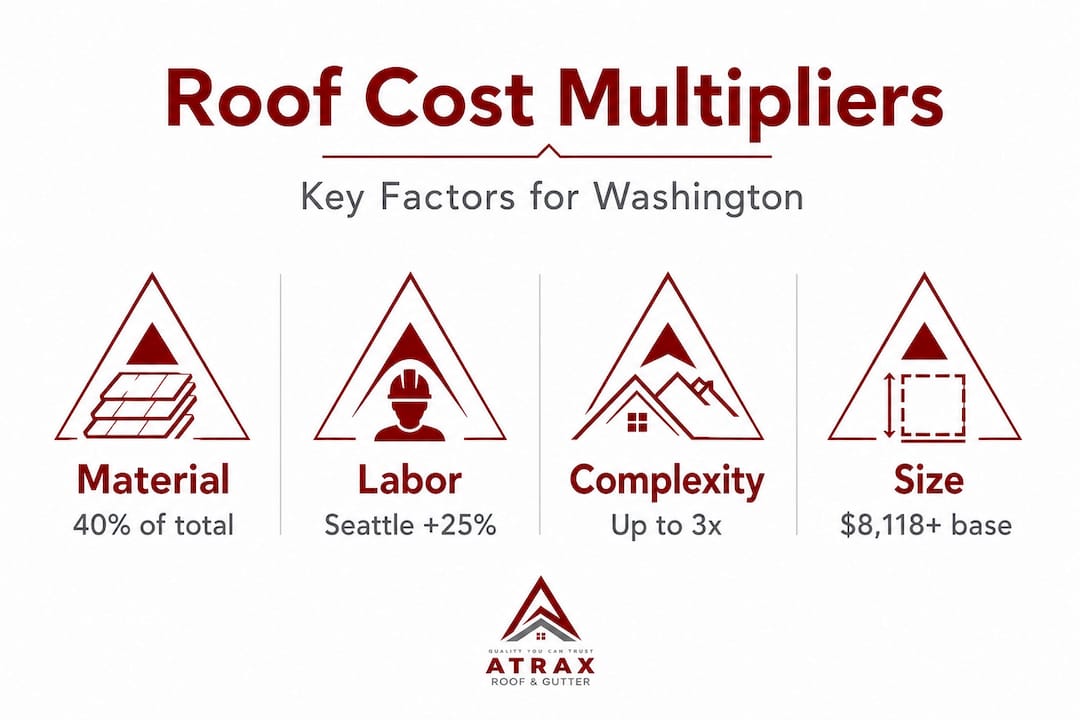
Material and labor are the two largest line items. Labor in the greater Seattle and Eastside area runs higher than national averages due to local wages and demand. On the material side, basic asphalt starts around $6.15 per sq ft while premium options like standing seam metal can climb to $37 per sq ft or more. Those are not small differences.

Roof complexity matters just as much as raw square footage. A simple gable roof on a ranch-style home is straightforward to install. A steeply pitched roof with multiple valleys, dormers, skylights, and complicated angles can easily add 30% to 50% to your total labor cost. Every penetration, valley, and hip adds time and material.
Roof size, ventilation, and moisture detailing are the key cost multipliers contractors often underquote in early conversations. Proper ventilation is not optional in Washington. Neither is a reliable moisture barrier. Skipping or shortchanging these items to hit a low bid number creates future repair costs that far exceed what you saved.
Here is a quick comparison to orient your planning:
| Material | Approx. cost per sq ft | Expected lifespan | Climate suitability (W. WA) |
|---|---|---|---|
| 3-tab asphalt shingles | $3.50 to $5.50 | 15 to 20 years | Acceptable, limited moss resistance |
| Architectural asphalt | $5.50 to $9.00 | 25 to 30 years | Good, better wind and weather resistance |
| Algae-resistant asphalt | $6.00 to $10.00 | 25 to 30 years | Excellent for wet, mossy conditions |
| Metal roofing | $10.00 to $37.00 | 40 to 70 years | Excellent, low maintenance long-term |
| Cedar shake | $12.00 to $18.00 | 20 to 30 years | Fair, requires significant upkeep |
Key factors that shape your final quote:
- Total roof surface area measured in roofing squares (1 square = 100 sq ft)
- Pitch and steepness (low, medium, or steep slope)
- Number of layers being removed before new installation
- Condition of the existing decking and whether replacement is needed
- Flashing material and number of penetrations (chimneys, vents, skylights)
- Ventilation system design and any required upgrades
Washington roof replacement averages $8,118 on the lower end but rises significantly with larger homes, complex designs, or premium materials. Understanding which variables apply to your home puts you in control of the conversation before any contractor sets foot on your property.
Pro Tip: Before requesting bids, sketch a rough diagram of your roofline and count your penetrations. This helps contractors give you an accurate quote faster and signals that you are an informed homeowner.
Thinking ahead about roof maintenance after replacement is also part of your total cost picture. A roof that gets proper annual maintenance will last decades longer than one that is installed and forgotten.
Washington code basics: Don’t cut corners on ventilation and moisture barriers
Washington State has specific building code requirements that apply to every roof replacement. These are not suggestions. They are legal minimums, and they exist to protect both your home and your family.
Washington Administrative Code Section 51-50-1202 mandates a minimum net free ventilating area of 1/150 of the attic floor space, along with a minimum 1-inch airspace between the insulation and the roof sheathing. This airspace allows moisture-laden air to exit the attic rather than collecting and causing rot, mold, and premature shingle failure.
“Ventilation requirements are not just a bureaucratic formality. They are the structural safeguard that keeps your attic dry, your insulation effective, and your roof system working as designed in Washington’s wet climate.”
Here is what proper ventilation compliance looks like in practice:
| Ventilation requirement | Code standard | What happens without it |
|---|---|---|
| Net free ventilating area | 1/150 of attic floor | Trapped moisture, mold, sheathing rot |
| Airspace between insulation and deck | Minimum 1 inch | Blocked airflow, condensation buildup |
| Ridge and soffit vent pairing | Balanced intake/exhaust | Ineffective ventilation, void warranties |
Underlayment is equally critical. Proper underlayment installation is the difference between a roof that stays dry for 30 years and one that develops subtle leaks within five. In Western Washington, where annual rainfall routinely exceeds 35 inches, underlayment is your last line of defense when wind-driven rain pushes under shingles.
Your underlayment options include:
- Felt underlayment (15 lb or 30 lb): The traditional standard, affordable, but less moisture-resistant than modern alternatives
- Synthetic underlayment: Lighter, more tear-resistant, and superior moisture performance; now the industry standard for quality installations
- Self-adhering (peel-and-stick) underlayment: Best used in critical zones like valleys, eaves, and around penetrations for maximum leak protection
Skipping a quality underlayment to cut $200 from a bid is one of the worst financial decisions a Washington homeowner can make. If a moisture problem develops, you are looking at potential sheathing replacement, mold remediation, and interior water damage, all of which cost far more than the underlayment itself.
Pro Tip: Ask every contractor to specify the brand and type of underlayment in writing before you sign. If their bid says “standard underlayment” without a product name, ask for clarification. Premium jobs use named products with documented performance ratings.
For more detail on what a code-compliant installation includes, our roof replacement guidance page walks through what a quality project looks like from start to finish.
Selecting affordable, durable materials for Washington roofs
Choosing materials for a Washington roof is different from choosing for a dry climate like Arizona or Texas. Western Washington brings moss, algae, persistent moisture, and seasonal wind. The right material for your budget has to survive those conditions or you will spend more on repairs than you saved upfront.
Algae-resistant shingles are strongly recommended for Western Washington homeowners. These shingles contain copper granules embedded in the surface that inhibit algae and moss growth. They typically cost only slightly more than standard architectural shingles, making them a cost-effective upgrade that pays for itself by reducing cleaning frequency and extending roof life.
Here is how to evaluate your material options:
- Define your timeline. Are you planning to sell in 5 years or stay in the home for 30 years? That answer directly affects whether the higher upfront cost of metal or premium architectural shingles makes financial sense.
- Factor in maintenance costs. A cheaper shingle may require moss treatment every 2 to 3 years in Western Washington. Add those costs over a 20-year period before concluding it is the cheapest option.
- Check manufacturer warranty requirements. Some manufacturer warranties require specific underlayment and ventilation standards. If those standards are not met during installation, the warranty is void regardless of how new the shingles are.
- Consider metal roofing pros for long-term value. A metal roof costs more upfront but carries a 40 to 70-year lifespan with minimal moss or algae problems. For homeowners planning to stay long-term, the math often favors metal.
- Request itemized bids. This is the most important step for making apples-to-apples comparisons between contractors.
Material selection checklist:
- Does it carry an algae-resistance rating for Washington’s climate?
- Is it listed as an approved material for your specific roof pitch?
- Does it meet or exceed the manufacturer warranty requirements for ventilation and underlayment?
- Is the shingle class rated for the wind speeds common in your area?
- Can you verify the product is being sourced from a reputable supplier?
Regular roof cleaning also extends the life of any material you choose. Our roof cleaning tips explain how to safely remove moss and algae without damaging shingles. If the upfront cost of premium materials is a concern, roof financing solutions may help you access the right materials today without straining your budget.
Smart budgeting: Comparing bids and managing hidden costs
Getting multiple bids is standard advice. But comparing bids the wrong way is one of the most common and costly mistakes Washington homeowners make during a roof replacement project.
Only compare bids that itemize materials, labor, ventilation, underlayment, and flashing. A bid that shows only a single total price tells you almost nothing. You have no idea what is included, what is excluded, or what will be added as a change order once work begins.
Here is a step-by-step approach to getting bids that actually protect you:
- Provide the same scope to every contractor. Share your roof dimensions, your target materials, and any known issues (like soft spots in the decking) before asking for pricing.
- Request line-item breakdowns. Ask each contractor to separate materials, labor, tear-off, disposal, underlayment, ventilation, and flashing as distinct line items.
- Ask about decking replacement pricing upfront. Many low bids assume your decking is in perfect condition. Ask what the per-sheet cost is for replacing damaged OSB or plywood, so you are not surprised mid-project.
- Verify code compliance is included. Ask directly: “Does your quote include all ventilation and moisture barrier requirements per Washington code?” A trustworthy contractor will say yes without hesitation.
- Clarify the warranty. Understand the difference between the manufacturer’s material warranty and the contractor’s workmanship warranty. A 20-year workmanship warranty from your installer means they stand behind the installation itself, not just the shingles.
Questions to ask every contractor before signing:
- Are you licensed, bonded, and insured in Washington State?
- What underlayment product do you use, and why?
- How do you handle decking damage discovered during tear-off?
- What is your ventilation plan for my specific attic configuration?
- Do you handle permit applications, or is that my responsibility?
For ongoing roof maintenance insights, understanding what good post-installation care looks like will also help you evaluate whether a contractor is giving you a complete picture or hiding future costs in vague scope language.
Pro Tip: If a bid comes in dramatically lower than the others, do not celebrate yet. Ask which line items were omitted. Nine times out of ten, a bid that is 25% cheaper has cut ventilation, underlayment quality, or both.
Why true budget roof replacement means smarter, not just cheaper, choices
We have seen it many times over our years in this business. A homeowner chooses the lowest bid by a significant margin and feels good about the savings. Eighteen months later, they are calling us about a leak, failing ventilation, or moss growing back faster than expected. The money they saved upfront is now a fraction of what the repair costs.
The Pacific Northwest demands more from a roof than most regions of the country. Moss and algae are not cosmetic issues here. They break down shingles, retain moisture, and accelerate deterioration at a rate that homeowners in drier climates never experience. A budget strategy built on national-average thinking will consistently underperform in Western Washington.
True cost efficiency comes from three places. First, choosing materials rated for Washington’s specific climate, not just the cheapest material on the market. Second, ensuring installation fully meets code for ventilation and moisture control, because cutting those corners creates future repair bills that dwarf the original savings. Third, working with an installer who documents everything, stands behind their work with a real warranty, and communicates honestly throughout the project.
Design and installation quality are just as important as material price. A premium shingle installed incorrectly will fail faster than a basic shingle installed by a skilled, detail-oriented crew. The workmanship is where the real value lives.
Our roof repair expertise page shows how quickly repair costs compound when a budget installation cuts the wrong corners. We believe the smartest budget decision a Washington homeowner can make is to invest in quality installation once, rather than repair work repeatedly.
Take the next step for your Washington roof replacement
If this guide has helped clarify your approach, you are already ahead of most homeowners who enter the bidding process without this foundation. At Atrax Roof & Gutter, we believe an informed homeowner is our best customer. We give you honest, itemized quotes with no surprises, and every job we complete is backed by our 20-year workmanship warranty and our commitment to using only premium GAF and CertainTeed materials.
We serve Kirkland, Bothell, Redmond, Bellevue, Seattle, and dozens of surrounding communities. Whether your project is straightforward or complex, we bring the same level of care and craftsmanship to every home we protect. Explore our roof financing options to see how we can help spread the cost of your replacement without compromising on quality. Browse our roofing portfolio to see real completed projects across the region. When you are ready to talk details, Atrax Roof & Gutter is here to guide you every step of the way.
Frequently asked questions
What is the average cost to replace a roof in Washington State?
The average replacement cost ranges from about $8,118 to $21,493 depending on materials, size, and complexity, with architectural asphalt averaging around $21,493 for a typical home.
Are algae-resistant shingles worth the investment in Washington’s wet climate?
Yes. Algae-resistant shingle technology combined with routine maintenance is strongly recommended for Western Washington, where moss growth actively shortens roof lifespan.
What code requirements must budget roof replacements follow in Washington?
Washington code requires a minimum net free ventilating area of 1/150 of attic floor space with at least a 1-inch airspace, plus a properly installed moisture barrier underlayment throughout the roof system.
How can I compare roof replacement bids to ensure I’m getting the best value?
Only treat bids as comparable when they itemize materials, labor, ventilation, underlayment, and flashing separately so you can see exactly what each contractor is including or omitting.
Does proper roof underlayment make a difference for budget-conscious projects?
Absolutely. Underlayment installation details directly affect leak resistance and long-term durability, making it one of the most cost-effective areas to prioritize rather than cut on any Washington roof project.


