

Getting a roofing estimate should feel straightforward, but most homeowners in Washington State quickly discover that quotes can look wildly different from one contractor to the next. One gives you a detailed two-page breakdown; another hands you a single number on a sticky note. When you’re protecting one of the biggest investments you’ll ever make, that kind of uncertainty is frustrating and financially risky. This guide walks you through exactly what a solid estimate must include, what Washington’s legal requirements mean for your project, how to judge whether a price is reasonable, and how to compare bids so you’re never caught off guard.
Table of Contents
- What a proper roofing estimate should include
- Understanding Washington State regulations and permits
- Deciphering cost estimates: Benchmarks and materials
- How to compare roofing estimates and avoid common pitfalls
- The expert’s angle: Why most roofing estimate mistakes happen
- Ready to compare estimates or need expert advice?
- Frequently asked questions
Key Takeaways
| Point | Details |
|---|---|
| Demand detailed estimates | Make sure every quote lists labor, materials, permits, and warranties separately. |
| Confirm contractor registration | Always verify your roofer’s registration and insurance through Washington’s L&I. |
| Know permit requirements | Understand when roof permits are necessary to avoid legal and cost issues. |
| Check local price benchmarks | Use Washington-specific roof cost guides to evaluate if your quote is reasonable. |
| Compare scope, not price alone | Match scope details across estimates to prevent hidden extra costs. |
What a proper roofing estimate should include
With an overview of the challenges in mind, let’s look at what a trustworthy roofing estimate document actually looks like and what it must contain.
A roofing estimate is not just a number. It is a written commitment that defines the scope of the entire project. A good roofing estimate should spell out the scope of work, materials to be used, timeline, and itemized material and labor costs — not just a single lump-sum number. When an estimate skips these details, it’s nearly impossible to hold the contractor accountable if something goes wrong.
Here is what every professional estimate should contain:
- Itemized cost breakdown: Separate line items for labor, materials, permits, disposal fees, and any contingency work. A single lump sum is a red flag.
- Material specifications: The brand, grade, and color of shingles or panels being installed. “Asphalt shingles” is not enough. You want “GAF Timberline HDZ, Charcoal, 30-year architectural.”
- Project timeline: Start date, estimated completion, and what happens if weather delays the work.
- Company credentials: Business name, license/registration number, physical address, and proof of insurance.
- Warranty information: Separate lines for the manufacturer’s material warranty and the contractor’s workmanship warranty.
- Decking replacement plan: This is one of the most overlooked items. The estimate should state what happens if damaged decking is discovered mid-project, including a per-sheet cost for replacement.
- Permit responsibility: Who pulls the permit and who pays for it?
Comparison table: Itemized estimate vs. lump-sum quote
| Item | Itemized estimate | Lump-sum quote |
|---|---|---|
| Labor cost | Listed separately | Hidden in total |
| Material brand/grade | Specified | Unknown |
| Permit fees | Line item | Unclear |
| Decking replacement plan | Defined cost per sheet | Absent or vague |
| Warranty details | Written, specific | Verbal or missing |
| Dispute resolution | Easy, clear | Difficult |
Pro Tip: Always ask your contractor, in writing, what the per-sheet cost will be if they discover damaged decking once the tear-off begins. In Washington’s wet climate, hidden moisture damage is common. Knowing this cost upfront prevents a mid-project argument over a surprise bill. It also helps you plan a realistic budget reserve of 10 to 15 percent above the quoted total.
Once you receive an estimate with all these elements, you can then start thinking about the long-term picture. Knowing what materials were installed and under what warranty terms is also essential for maintaining your roof after replacement, so keep a copy of the estimate in a safe place even after the project is complete.
Understanding Washington State regulations and permits
Knowing what belongs in an estimate, it’s vital to connect those details to Washington’s legal and permitting landscape to ensure compliance and proper pricing.
Washington State has specific requirements for contractors that directly affect what you should see in any legitimate roofing bid. Roofing contractors in Washington are registered and regulated through the Department of Labor and Industries (L&I) rather than through a separate roofing-only occupational license. This means you need to verify their L&I registration number, not just take their word for it. Every legitimate contractor will have this on file, and you can verify it for free on the L&I website.
Key requirements for Washington contractors:
- L&I registration: Mandatory for any contractor performing work over $500.
- Liability insurance: Contractors must carry general liability coverage.
- Surety bond: Required by the state to protect homeowners from incomplete or defective work.
- Workers’ compensation: If the contractor has employees, they must carry this coverage.
Warning: Hiring an unregistered or uninsured contractor voids your ability to file a complaint with L&I and may leave you personally liable if a worker is injured on your property. Beyond that, work done without required permits can result in fines, forced removal of the new roof, and complications when you try to sell your home later.
On the permit side, Washington’s rules vary by city and project type. Permits for roof replacement are typically required when a project involves roof decking replacement, structural repair, skylight installation, or other material and structural changes. A straightforward shingle-for-shingle replacement may be exempt in Seattle and many surrounding cities, but you should never assume.
Data table: Permit requirements by roof job type in Washington State
| Job type | Permit typically required? | Notes |
|---|---|---|
| Like-for-like shingle replacement | No (in most cases) | Verify with your city’s building dept. |
| Roof decking replacement | Yes | Common in WA due to moisture damage |
| Adding skylights | Yes | Structural opening involved |
| Flat roof replacement (material change) | Often yes | Check flat roofing regulations |
| Structural repairs to rafters | Yes | Engineer review may be needed |
| Roof cleaning or moss treatment | No | See roof cleaning compliance |
Any estimate you receive for a job that requires a permit should include the permit fee as a line item. If it doesn’t appear, ask directly. A contractor who says “don’t worry about permits” is one you should not hire. For roof repair in Washington, the same rules apply depending on the scope and structural impact of the repair.
Deciphering cost estimates: Benchmarks and materials
Once compliance and registration are checked, the real question is whether the quoted price makes sense for your type and size of roof.
Price ranges for roofing in Washington vary significantly based on material choice, roof complexity, and labor costs in your area. Washington State roofing costs are commonly benchmarked in per-square-foot terms that vary heavily by roofing type. A basic asphalt shingle roof runs approximately $6.15 per square foot, while high-end copper roofing reaches around $37 per square foot.
For a typical 1,700 square foot home, that translates to a realistic cost range of roughly $10,500 for entry-level asphalt shingles to $63,000 or more for copper. Most Washington homeowners land somewhere in the middle with architectural asphalt shingles, standing seam metal roofing, or composite materials.
Factors that push prices higher include:
- Moisture and decking damage: Washington’s rain and humidity mean decking replacement is common. Budget $3 to $5 per square foot extra if extensive rot is found.
- Roof pitch and complexity: Steep roofs, multiple valleys, and dormers add labor time and safety equipment costs.
- Material upgrades: Moving from 3-tab asphalt to architectural shingles adds roughly $1 to $2 per square foot. Moving to metal or tile jumps significantly higher.
- Tear-off layers: Washington’s building code generally allows only one layer of shingles. If you have an older home with multiple layers already, full tear-off adds disposal costs.
- Gutters, flashing, and ventilation: These are often sold as add-ons. Clarify upfront whether the estimate includes new flashing around chimneys and skylights.
For a detailed breakdown of what metal materials cost and when they make financial sense, review our metal roofing price guide. If you’re still deciding between a repair or a full replacement, our roof replacement costs page provides transparent pricing by material type.
Pro Tip: When an estimate looks unusually low, don’t celebrate yet. Ask what specific material grade is being quoted and whether decking replacement is included or excluded. Contractors who win bids with low prices often recover that margin through “extras” discovered mid-project. Get every assumption in writing before signing anything.
How to compare roofing estimates and avoid common pitfalls
With a sense of reasonable prices, the next skill is ensuring you compare estimates objectively and protect yourself from hidden extras.

The most common mistake Washington homeowners make is treating estimates like shopping for a TV, where the lowest price on the same model wins. Roofing estimates are not the same product in different packaging. Every estimate reflects different assumptions about scope, materials, and contingencies.
Best-practice comparison means treating each quote as a “scope document” and ensuring the bids are comparable on what’s being replaced — including tear-off extent and decking replacement assumptions — not just on total price.
Steps for comparing bids effectively:
- List the scope items from each estimate side by side. Create a simple spreadsheet with rows for each line item and a column for each contractor.
- Confirm each estimate uses the same material grade. If one quote uses 3-tab shingles and another uses architectural, you’re not comparing fairly.
- Check what each estimate says about decking. Does it include replacement, exclude it, or leave it ambiguous? Decking replacement and moisture-related deterioration in Washington’s damp climate can turn a repair-sized scope into a much bigger job.
- Verify warranty terms are equivalent. A 10-year workmanship warranty and a 20-year workmanship warranty are not the same thing.
- Confirm permit responsibility is included. If two estimates look identical but one includes permit fees and the other doesn’t, that could be a $500 to $1,500 difference depending on your city.
- Ask for references or past project photos. A contractor confident in their work will have no trouble directing you to examples of past projects.
Comparison table: Scope and price line items across two bids
| Line item | Contractor A | Contractor B |
|---|---|---|
| Shingle material | GAF Timberline HDZ | Generic 30-year |
| Decking replacement | $75/sheet extra | Not mentioned |
| Permit fees | Included | Not included |
| Workmanship warranty | 20 years | 5 years |
| Disposal and cleanup | Included | $350 extra |
| Total quoted | $14,200 | $12,800 |
| Adjusted real cost estimate | $14,200 | $14,500+ |
As you can see from this example, the lower bid can easily become the higher actual cost once you fill in the blanks.
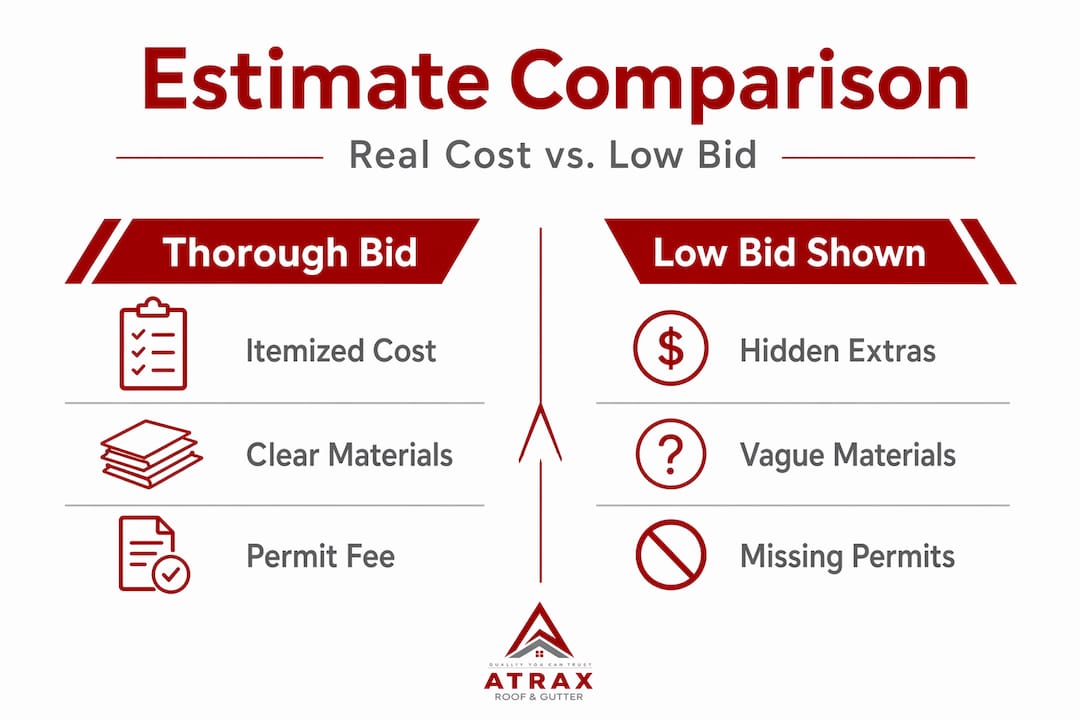
Pro Tip: Request explicit written alternatives for uncertain structural or decking repairs before work begins. Ask each contractor: “If you find more than 5 sheets of damaged decking, what is the per-sheet charge and how will I be notified before you proceed?” This one question separates professional contractors from those who prefer to surprise you.
The expert’s angle: Why most roofing estimate mistakes happen
After learning the technical details, it’s worth considering the practical lessons that come from years in the industry.
In our experience, the root cause of almost every estimate-related dispute is not fraud. It’s ambiguity. Contractors make assumptions. Homeowners make assumptions. Nobody writes those assumptions down. Then Washington’s rainy season reveals what the roof was actually hiding, and a bill arrives that nobody expected.
We’ve seen this pattern repeatedly: a homeowner receives three quotes, chooses the middle price, and feels confident they made a rational decision. But the middle-priced contractor assumed no decking replacement. Once the tear-off revealed widespread moisture damage, the project cost jumped by $4,000. The homeowner felt deceived, but the contractor felt the contract was clear. Both were partially right. The real failure was a lack of explicit contingency planning in the estimate itself.
The uncomfortable truth is that many homeowners are so relieved to get through the intimidating process of gathering bids that they stop asking questions too early. They read the total, check that the contractor seems reputable, and sign. The scope document review, the warranty comparison, and the decking replacement conversation get skipped.
Our advice is to spend more time on the estimate review than on any other part of the process. Washington’s climate is unforgiving. Moisture gets into places you can’t see. The contractor who plans transparently for that reality, with written contingencies and a clear communication process, is the one worth hiring. Check their reviewing project outcomes history and ask for references from jobs completed in the last 18 months.
Overcommunication is not a burden in this industry. It is the only real protection you have.
Ready to compare estimates or need expert advice?
Having equipped you with effective strategies for reading and comparing roofing estimates, here are helpful resources for your project journey.
At Atrax Roof and Gutter, we’ve built our entire process around the kind of transparency this guide describes. Every estimate we provide is fully itemized, includes a clear decking replacement policy, and reflects Washington State permit requirements upfront. No surprises, no hidden extras.
You can see completed projects from homeowners across Kirkland, Bothell, Bellevue, Seattle, and surrounding communities to get a realistic sense of what a professionally finished roof looks like. If budget is a concern, explore our roof financing options to find a payment plan that fits your situation. When you’re ready to move forward, request a roof repair quote and experience firsthand what an honest, detailed estimate looks like. We back every job with a 20-year workmanship warranty and a 100% satisfaction guarantee.
Frequently asked questions
How can I verify a roofing contractor’s license in Washington State?
You can search a contractor’s registration status on the Washington Department of Labor and Industries website at no cost. Washington contractors must be registered with L&I and carry both insurance and a surety bond before legally performing roofing work.
What details should be included in a roofing estimate?
A complete roofing estimate should list the full scope of work, itemized labor and material costs, project timeline, warranty details, permit responsibility, and a written plan for handling unforeseen issues like damaged decking.
Do I need a permit for all roofing jobs in Seattle?
Not for every job. Simple shingle-for-shingle replacements are typically exempt, but structural repairs, decking replacement, and skylight installations require a permit. Always confirm with your city’s building department before starting work.
What is the typical cost range for a residential roof in Washington?
For a 1,700 square foot roof, costs range from roughly $10,500 for basic asphalt shingles to $63,000 for high-end copper. Washington’s per-square-foot costs vary from about $6.15 for asphalt to $37 for copper, with many factors affecting the final number.
What’s the biggest mistake homeowners make when comparing estimates?
Most homeowners focus on the total price rather than matching scope details between bids. Treating each quote as a scope document and comparing line items like decking replacement plans, permit fees, and warranty terms reveals the true cost difference between contractors.


